
Russian Banya: What It Is and the Best in Moscow and St. Petersburg
 By Irena Domingo
Updated on
In This Article
The banya is Russia’s traditional steam bath and probably the most authentic experience you can have in the country. It’s far more than a sauna: it’s a ritual of health and relaxation, but above all a place to socialize with friends and family. If you only visit one, make it Sanduny, in Moscow: the oldest public banya in the country (running since 1808) and the most spectacular of them all. I’ll tell you exactly what a banya is, how the ritual works, and which are the best ones in both Moscow and St. Petersburg.
What a Russian banya is
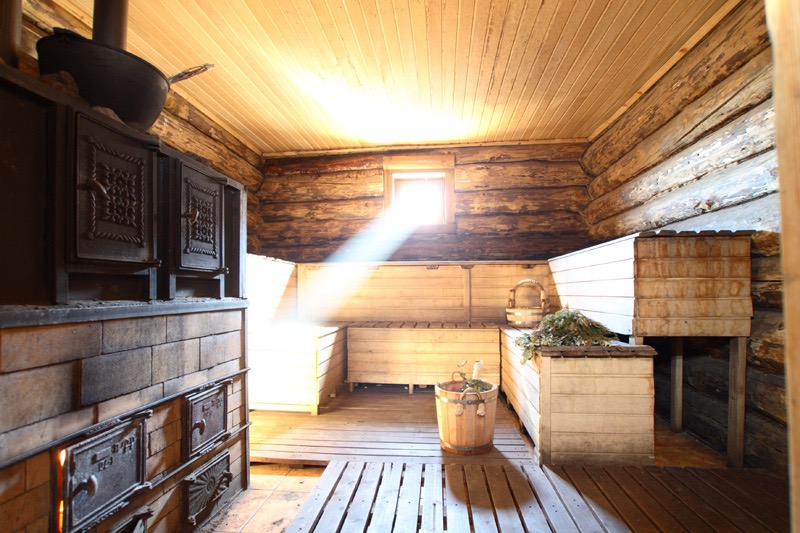
Russians say you can’t really claim to have been to Russia unless you’ve had a proper soak in a typical banya. It’s something like a modern spa —with a sauna, steam, massages and a lounge area— but with centuries of tradition behind it. The custom runs so deep that for many Russians it’s still a weekly date, and not only to unwind: the banya is also where you eat, drink and chat for hours with your own people. Bear in mind this is a country where it gets very cold.
The tradition is so embedded in popular culture that the quintessential New Year’s Eve comedy, The Irony of Fate (1975), opens precisely with a group of friends seeing in the New Year at a banya. In Russia it’s re-aired every December 31st.
The banya ritual: how it works step by step
The first thing to know is that banyas are separated by sex: there’s a section for men and another for women. Inside each one you’ll find three spaces:
- A changing room and lounge area, where you keep your things in a locker, get undressed (you can cover up with a towel) and, between rounds of steam, sit down to chat, eat and drink.
- A shower and washroom area.
- The steam room, where the temperature can top 100 ºC (212 ºF).
The ritual is a circuit you repeat several times: you shower, go into the steam room to sweat, come out and pour buckets of cold water over yourself (or, if you’re at a dacha out in the countryside, you throw yourself straight into the snow), and then head back in. Between rounds, you rest in the lounge with tea, kvas, beer or vodka and something to eat. The whole thing can easily last a couple of hours.

The most distinctive detail is the venik: a leafy bundle of branches (usually birch or eucalyptus) used inside the steam room to gently swat your back and get the circulation going. That’s why people walk out of the banya with rosy skin. And one last piece of advice: nobody here is shy. You’ll walk and sit naked alongside friends, colleagues or complete strangers, so relax and enjoy it like everyone else.
Private and public banyas
Many Russians have their own family banya at the dacha (the country house), in a small wooden cabin. But in the big cities the norm is the public banya, open to everyone for an entrance fee. The best and most famous ones are in Moscow and St. Petersburg, and those are the ones that matter to you if you’re traveling as a tourist.
Sanduny: Russia’s most famous banya (Moscow)
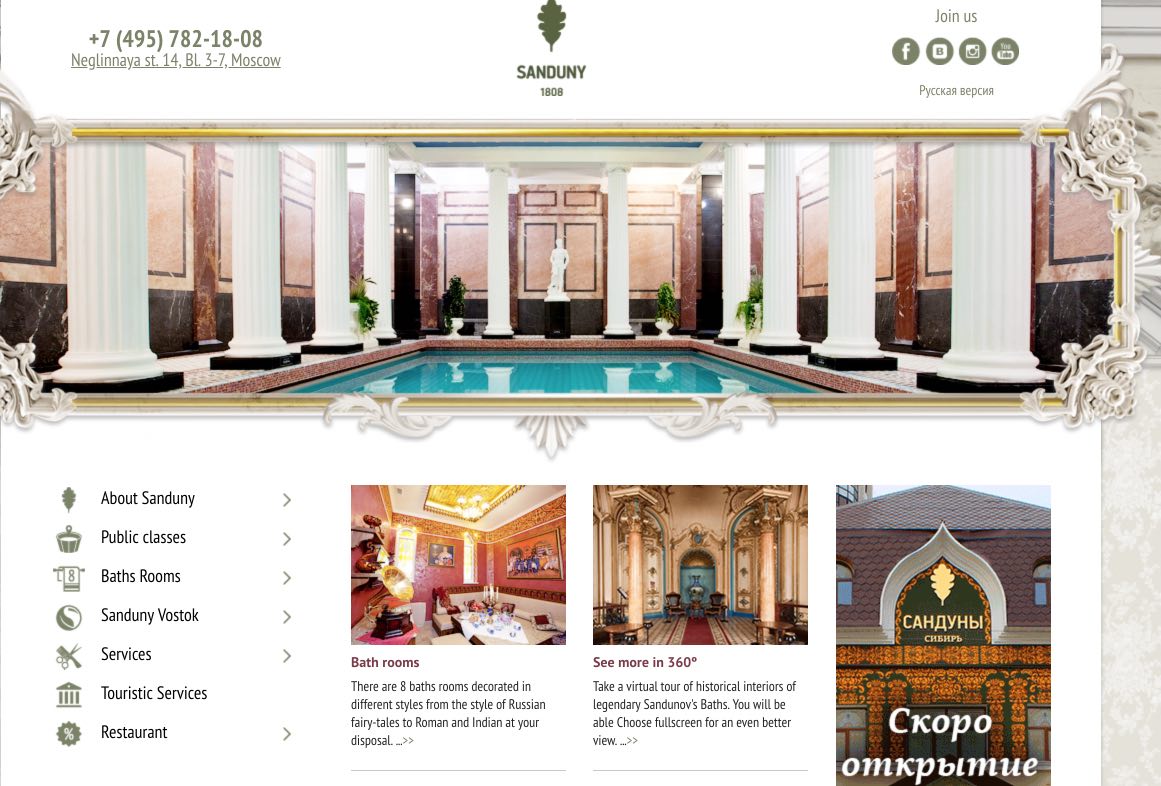
If you’re only ever going to set foot in one banya in your life, make it this one. The Sanduny Baths (Sandunovskie bani) have run without interruption since 1808 and are the oldest and most luxurious in Moscow. They occupy a genuine architectural gem in the Beaux Arts style at 14 Neglinnaya Street, right by the Bolshoi Theatre. They’re named after their founder, the actor Sila Sandunov. Everyone from writers like Pushkin, Tolstoy and Chekhov to politicians, athletes and business people has passed through these halls —the latter also using them as a place to close deals.
The categories (разряды) and prices
In keeping with the separation by sex, Sanduny has four men’s categories (разряды) and one women’s, each with its own decor and price. The most impressive is the Men’s Top Class: historic interiors, a Gothic-style lounge, cabins that look like old train compartments and, above all, the famous Roman-style pool that appears in Eisenstein’s Soviet film classics such as Battleship Potemkin and Alexander Nevsky.
These are the approximate prices for general admission (2 hours) according to the official website:
- Men’s Top Class (the most luxurious): around 5,500 ₽ on weekdays until 5:00 pm, and 6,000 ₽ in the evenings, on weekends and on public holidays.
- Other categories (Second Top and First Class for men, and the women’s section): between roughly 3,500 and 4,600 ₽, with simpler interiors.
- Children aged 7 to 18 pay roughly half price; under-7s get in free (without a spot of their own).
Prices change and each category keeps different hours, so always confirm on the official разряды page before you go. Do keep one important rule in mind: you’re not allowed to bring your own food and drink; there’s a restaurant inside the complex.

Private rooms for groups
If you’re after more privacy or you’re going with your partner, family or friends, Sanduny rents out themed private rooms, each with its own sauna and pool. Their names give you a clue about the decor: Lukomorye, Kupechesky (the Merchant’s), Kandarya and Soviet (up to 4 people), Sadko and Roman (up to 6), or Kamchatka and Baikal (up to 10). They’re the ideal choice for celebrating something, though also the priciest. It’s worth booking them well in advance.

Guided tour (if you’d rather not bathe)
If you can’t be bothered to undress but still want to see the building from the inside, Sanduny runs guided tours of its premises so you can learn the history of the baths and see its most spectacular rooms. You can check dates and book on the official tours page.
Opening hours and how to pay
Sanduny is open daily, generally from 8:00 am to 10:00 or 11:00 pm depending on the category. Each разряд also has its own cleaning day (a sanitary day) when it stays closed, so check the schedule of the section you’re interested in before you show up.
A heads-up on payment: since 2022, foreign Visa and Mastercard cards don’t work in Russia, and Sanduny is no exception. You’ll have to pay in cash in rubles or with a Russian card.
Other notable banyas in Moscow
Sanduny is the queen, but not the only one. If you’d like alternatives, here are some of the most recommendable in Moscow:
- Zhar-Ptitsa (The Firebird): set in late-19th-century buildings, with public baths separated by sex and six private rooms, each with its own atmosphere (from a Soviet-era setting to a mountain chalet) and its own steam rituals.
- Siberia: opened in 2022, a premium banya with five themed rooms inspired by Altai, the taiga and Lake Baikal, each set to its own sounds and scents. Very popular among serious steam lovers.
- Paveletskie: modern and elegant, with public halls, a pool, a hammam and a VIP room for groups of up to ten people.
The best banyas in St. Petersburg
St. Petersburg also has a strong tradition of public baths. The three most historic and best rated are:
- Yamskie Baths (Yamskie bani): probably the most popular and historic in the city, a full wellness complex with a Russian parnaya (steam room), saunas and a pool.
- Mytninskie Baths: among the city’s first public baths and still heavily used by locals themselves. An authentic, local atmosphere.
- Degtyarnye Baths: a large complex next to Nevsky Avenue, with a Russian parnaya, a Turkish hammam, a spacious pool and an ice-water plunge tub, plus professional masseurs.

Practical tips for your visit
- Bring (or rent on site) flip-flops, a towel and a wool hat: the hat protects your head from the steam room’s extreme heat and is practically a must.
- You don’t need to speak Russian, but be clear about what you want before you reach the front desk, as they may not speak English.
- If you’re going in a group or want privacy, book a private room in advance.
- Carry cash in rubles or a Russian card: Western cards don’t work.
Frequently asked questions about the Russian banya
What is a Russian banya?
It’s Russia’s traditional steam bath, similar to a spa with a sauna, a shower area and a lounge. More than a place to get clean, it’s somewhere to relax and socialize with friends and family, and it’s an important part of Russian culture.
How much does it cost to get into the Sanduny Baths in Moscow?
General 2-hour admission ranges from around 3,500 rubles in the simplest categories to about 5,500-6,000 rubles in the Men’s Top Class, the most luxurious. Children aged 7 to 18 pay roughly half and under-7s get in free. It’s worth confirming prices on the official website, as they change.
Do men and women go to the banya together?
No. Russian public banyas are separated by sex, with one section for men and another for women. If you want to share the bath as a couple or in a mixed group, the option is to rent a private room.
What should you bring to a banya?
Flip-flops, a towel and a wool hat to protect your head from the heat. Almost everything can also be rented or bought at the banya itself. At Sanduny you’re not allowed to bring food and drink from outside.
How do you pay at the banya in Russia?
In cash in rubles or with a Russian card. Since 2022, foreign Visa and Mastercard cards haven’t worked in Russia, so it’s best to bring cash in rubles or get a MIR card before your trip.
In This Article
Was this useful? I'll tell you when something changes in Russia
One short email a month with what has changed for travellers (visas, payments, border crossings, apps), based on what readers report to me from Russia. More than 4,000 of us already. No spam: if you ever lose interest, unsubscribing is one click.
Irena DomingoAbout Me
I was born in Russia. I grew up between two worlds: my father was Russian, my mother Spanish — a descendant of the "Children of Russia", the Basque children evacuated to the USSR during the Spanish Civil War. I've worked as a translator, interpreter and Russian teacher for over 30 years, and since 2013 I've been writing this blog to help travellers discover Russia with practical, always up-to-date information. Author of the Russiable Guide. If this blog has helped you plan your trip, you can buy me a coffee ❤️.
 Russian Circus in Moscow: The 3 Must-See Shows and How to Buy Tickets
 Russian Folklore Shows in Moscow and St. Petersburg
 Bolshoi Theatre Moscow: How to Buy Tickets as a Foreigner